Prioritizing close-up photos for labelling

labelfirst, the engine.  crownfirst, the BCI deployment.
Wietze Suijker
Hyperspatial drone meeting, 16 June 2026

The problem is the long tail
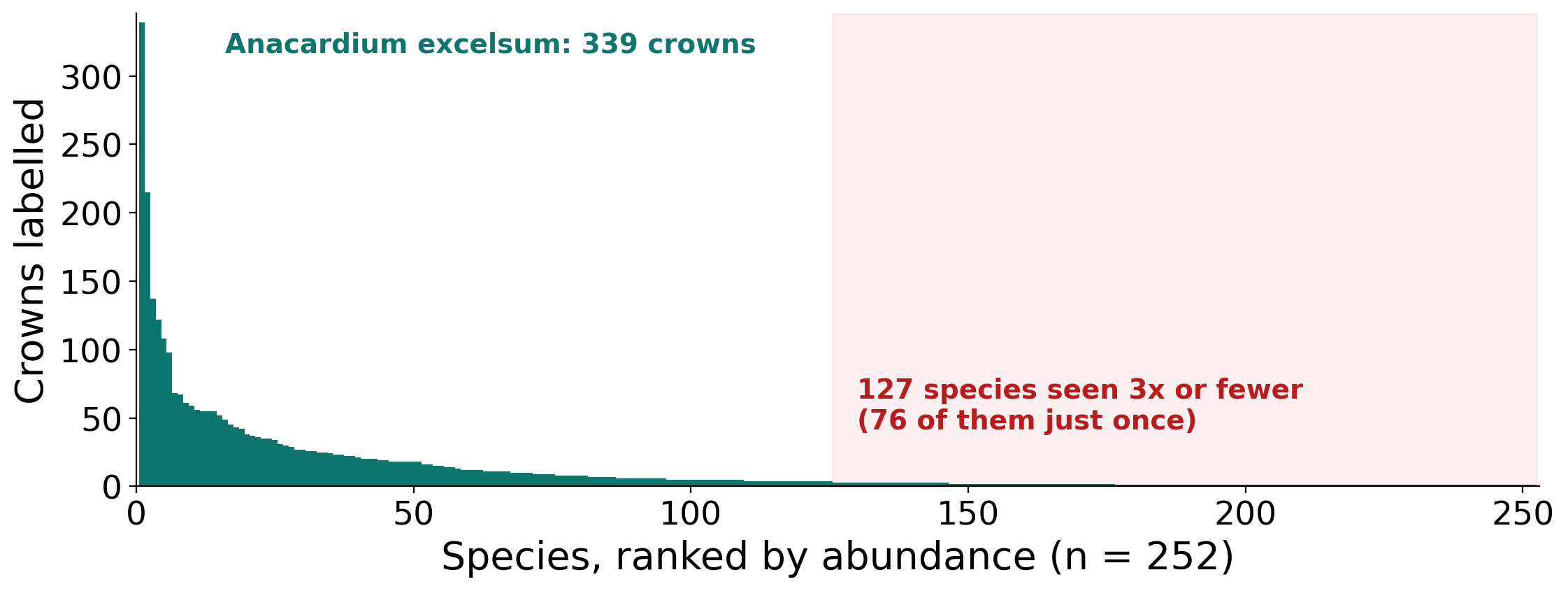
BCI long tail
Panama, Étienne
“Necesitamos encontrar las especies raras.”
So which photos does the botanist see first?

Two layers, one job

labelfirst (the engine)

  • which photo to label next
  • a pre-flight: is smart picking likely to beat random?

crownfirst (the BCI deployment)

  • tier by confidence, genus fallback
  • the Labelbox loop, the Pl@ntNet handoff

The hard part isn't choosing, it's seeing
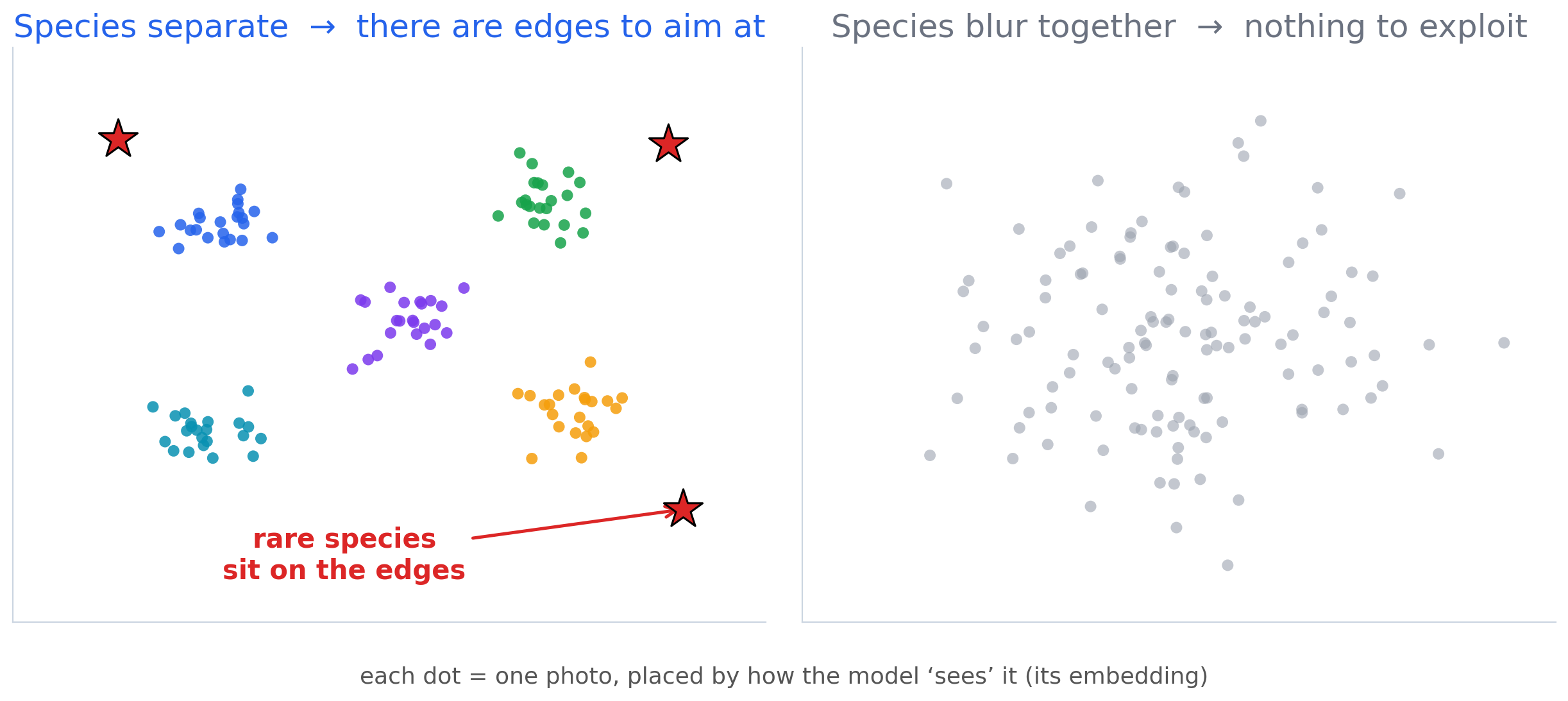
embedding intuition
When species separate, a smart queue heads for the sparse edges where the rare ones sit. When they blur together, there is nothing to aim at.

And we can measure it, before spending the budget
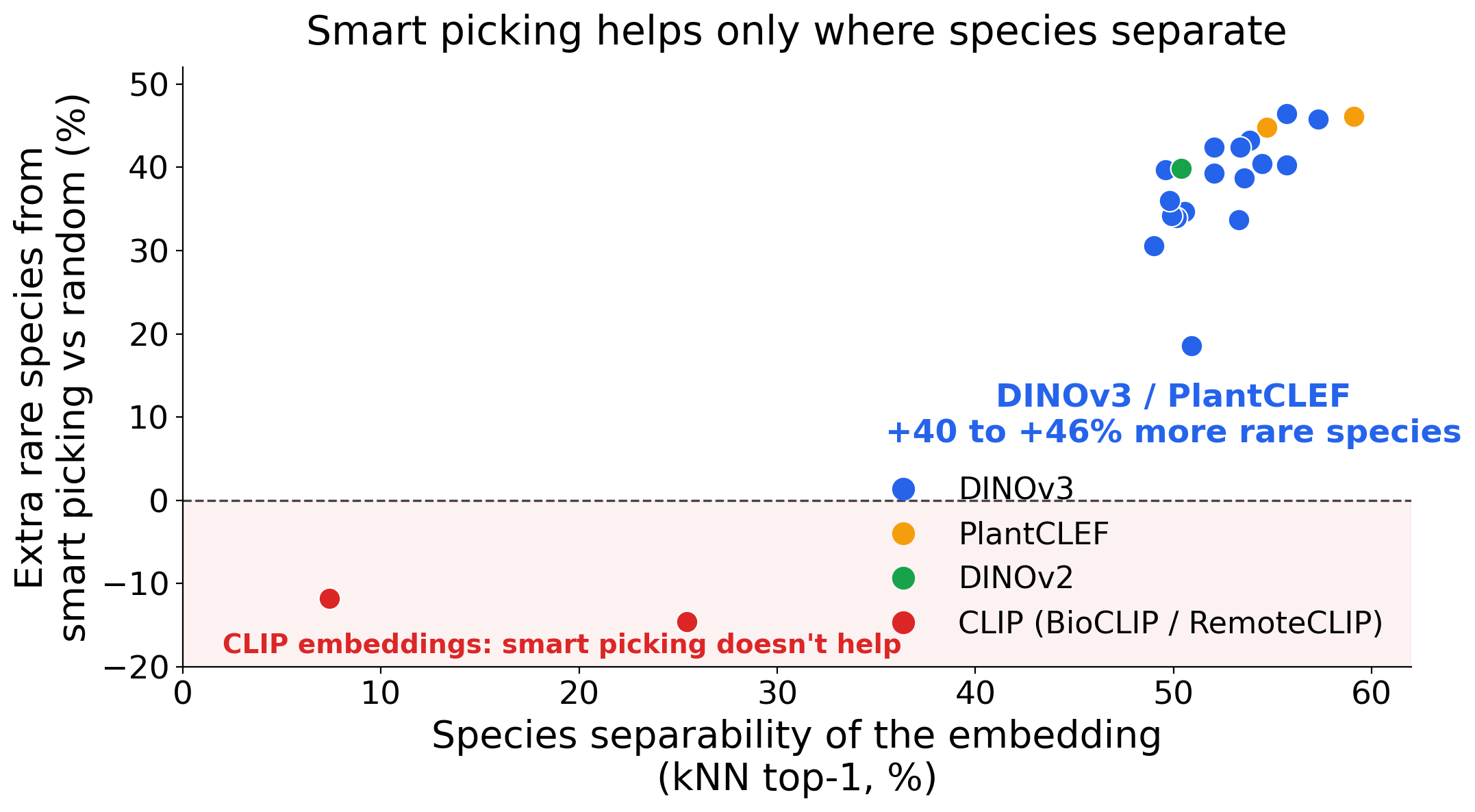
separability across 22 embeddings
A cheap pre-flight on the crowns already labelled catches this before you spend the budget.
The Pl@ntNet-family models score about 58%, at the top of the good regime.

On real BCI crowns, it pays off
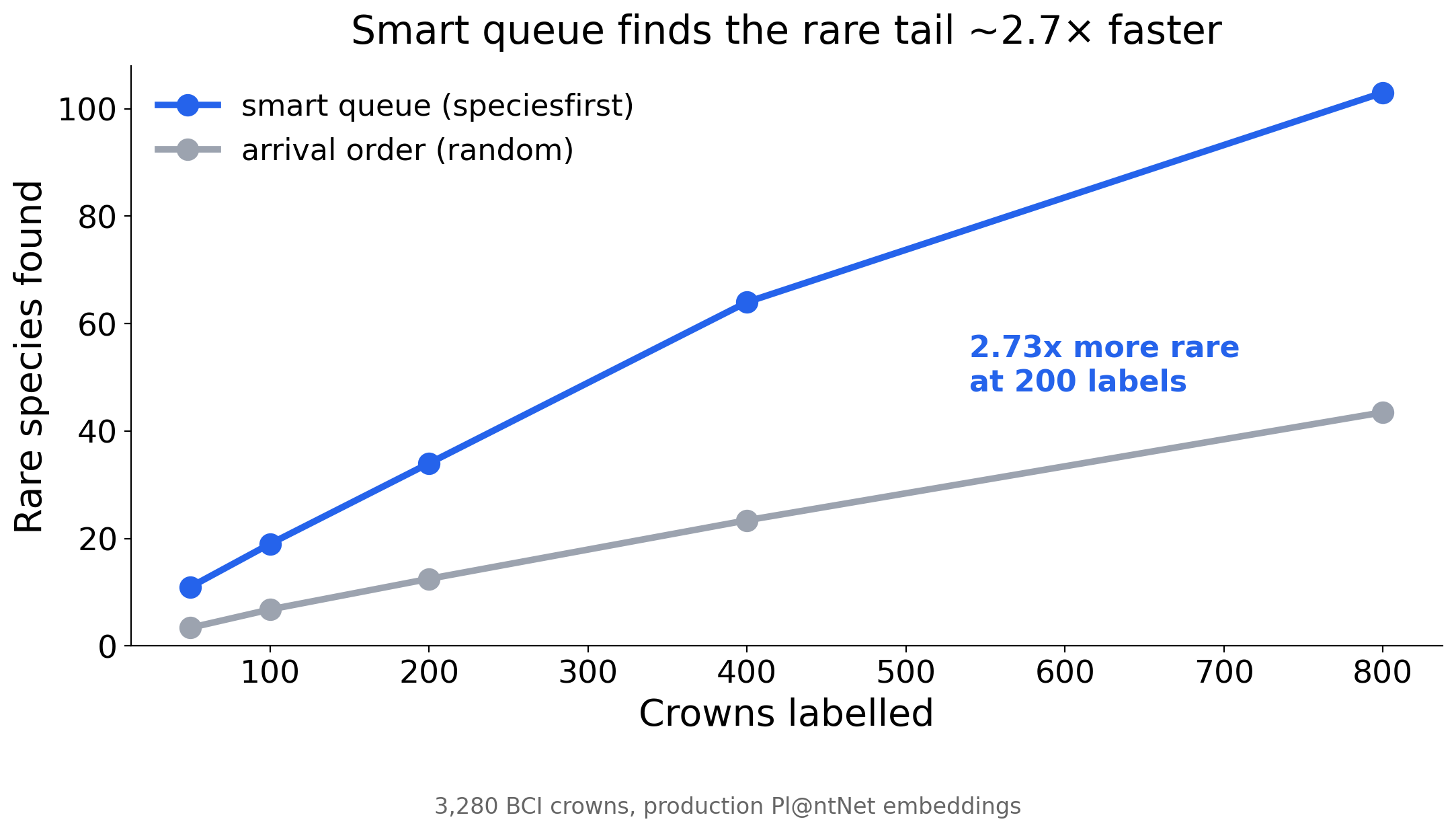
discovery curve
Tiering confidently narrows ~40% of labelled crowns to at most 3 species (57% with the genus fallback); retraining on your labels finds up to ~50% more rare species in simulation, an upper bound because the retrained model saw every common-species label.

Finding rare species, not just flowers

Jean-Christophe Lombardo (Pl@ntNet) asked. It holds.
+0.43
rarity predicts novelty
(even controlling for flowering, leaf state and bare crowns)
~7%
novelty explained by organ
(flowering, foliage, senescent, bare)

How it plugs into this room

  • Pl@ntNet (Pierre, Jean-Christophe): the WCVP label handoff feeds Pl@ntNet's next retrain
  • Antoine and Étienne's system: crownfirst is the photo-selection layer
  • Helene's held-out eval: separability and the sampling/classifier-limited split, tracked over time

Next steps

  • Ship the WCVP label handoff to Pl@ntNet
  • Go live on the Labelbox sandbox (Antoine)
  • Align bbox convention and orthorectification (Étienne, Antoine)
  • With Helene: design the held-out set that measures drift
Stop sending whole missions. Send the photos that find the rare tail.

Thank you

The bottleneck isn't data. It's attention: which photos get looked at.
labelfirst: which photo to label next, and whether it's worth it
crownfirst: the BCI deployment and the Pl@ntNet handoff

Wietze Suijker, wietze.suijker@mila.quebec
Evidence and code: traitlab/labelfirst, traitlab/crownfirst

Appendix: not a backbone coincidence

Could the benefit just be luck in which AI model we picked? We tested it the hard way.
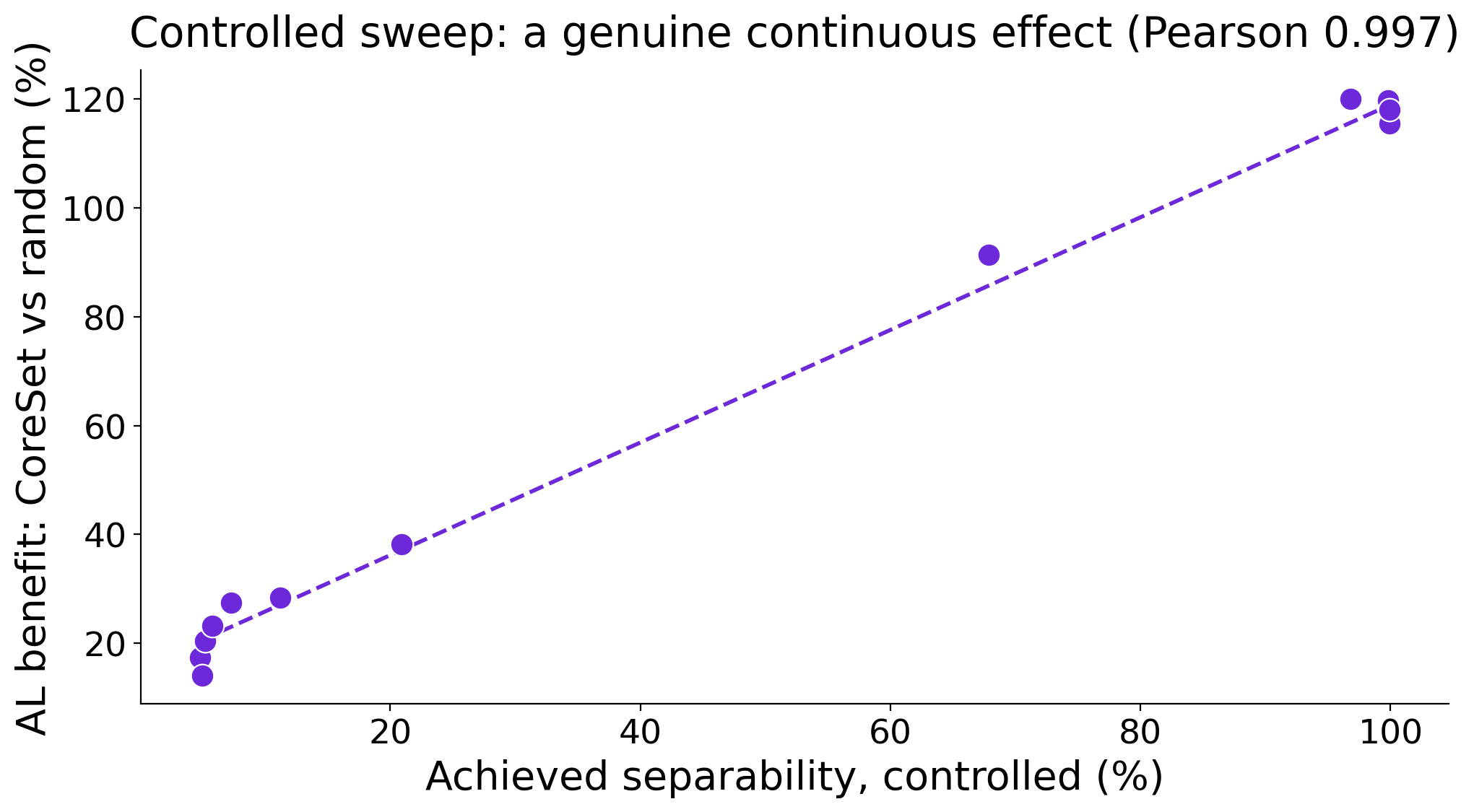
controlled sweep
  • Real models fall into two camps (CLIP vs DINOv3), so a single trend line across them would overstate a “law.” We say so.
  • So we ran a controlled sweep: dial species from blurred-together to cleanly-separated on purpose, and watch the benefit. In this synthetic test it rises smoothly.
  • Consistent across 3 checks: real models, this synthetic sweep, and a blur ladder on three real datasets (pooled R² 0.79).
  • The sweep changes more than separability, so it shows association, not that separability alone causes the gain.

Appendix: how we pick, and the pre-flight

One number, computed on the photos you have already labelled, signals whether smart picking is likely to beat random.
  • Picking the next photo: about 20 interchangeable strategies behind one call. The default, CoreSet, simply spreads picks to cover the space — no tuning, an unmodified 2018 method. (A co-pick, novel_margin, leans toward brand-new species when you expect them.)
  • The pre-flight — separability: how cleanly the model already sorts species apart, scored from the labels you already have, before you spend more.
  • It tracks the geometry, not a fluke: keep the photos and labels fixed, just blur the model's view, and the benefit falls with it (correlation 0.76 BCI, 0.94 PlantNet, 0.96 iNat).
  • A high score isn't a guarantee: we reshaped the embedding so its flat, noisy directions counted as much as the meaningful ones (a standard step called whitening). The score barely moved (52% → 51%), but the benefit nearly halved (39% → 23%) — now the picker spreads its choices into noise instead of toward the rare species, and a nearest-neighbour score can't catch that.

Appendix: we couldn't move the goalposts

The confirmatory camera-trap test was fixed before seeing any result, so we couldn't fool ourselves into a win. The forest-crown results are exploratory.
  • The rule, locked in advance: an exact test on the 16 paired runs, with a correction across related comparisons.
  • Why 16 runs: with all 16 pointing the same way, an exact sign-flip test reaches 1-in-65,536 (p = 2−16), enough margin to survive the correction; 5 runs wouldn't.
  • The mistake we keep on the slide: an early “our picker trains a better model” win turned out to be a test-set leak: the picker had peeked at the test crowns. Re-run cleanly, no picker came out ahead.

Appendix: what didn't work, and why that matters

We show the failures on purpose — they're the evidence we're not overselling.
  • Picking “needle” photos tucked inside other species' clusters lost to the novelty picker on every run (0/16). Odd-looking ≠ rare species.
  • “Cleaning up” the embedding first backfired for the default picker on DINOv3: it erased the very structure the picker relies on.
  • After retraining, a quick accuracy check barely moved while discovery jumped. Measure discovery directly.

So the contribution isn't a clever new algorithm — it's the honest, falsifiable test harness. An unmodified 2018 method plus that protocol beats a half-random hybrid and plain random, once photos nobody can label are kept out of selection (on the drone pool, re-proposing them put it 27% below random).

We also reproduce the difficulty score of the Beery transductive-needles method (Kurinchi-Vendhan & Beery 2026, arXiv:2606.03821; per-point correlation 1.000).