The Geometry of Discovery

A training-free pre-flight for finding unknown species
Wietze Suijker
training-free pre-flight · open-set recognition

Most species are unnamed. Most known ones are barely mapped.

The bottleneck isn't sensors or models. It's human attention: which specimen a taxonomist examines next, and where a naturalist goes next.
The question: can we predict, before spending a single label or field trip, where that attention will pay off? A cheap, a-priori “pre-flight” for discovery.

First, test the simplest hypothesis
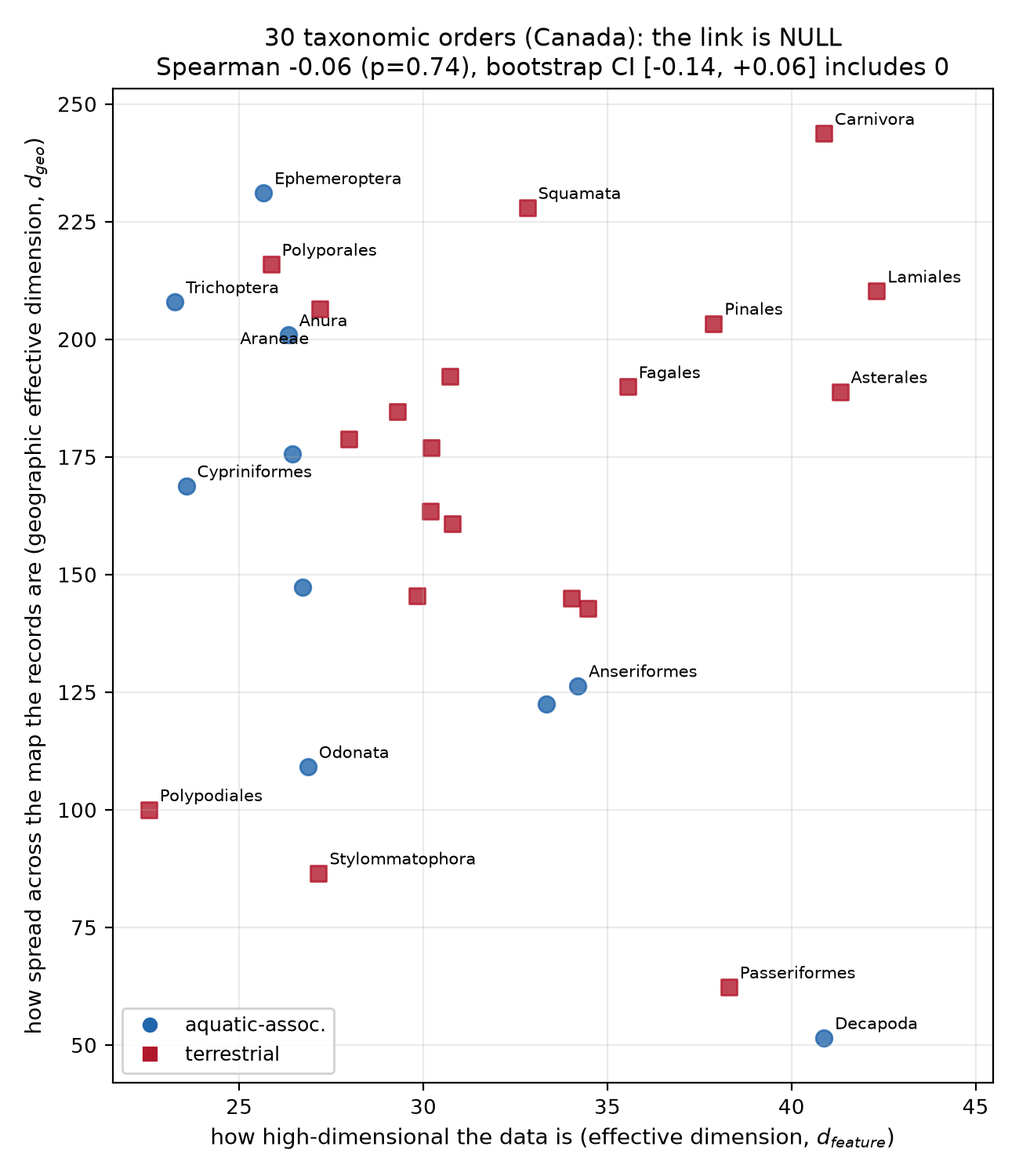
one-number hypothesis rejected
Hypothesis: a single statistic (effective dimension) governs both “which to label” (feature space) and “where to sample” (geographic space). Test: the same estimator on both axes, 30 taxonomic orders. Result: no association, Spearman −0.06, 95% CI [−0.14, +0.06], includes zero. The hypothesis is rejected; the strong coupling at a few coarse “iconic” taxa was an aggregation artifact. So the two axes are independent, and the pre-flight must be two-dimensional.

So what does govern discovery? The gaps, not the cloud.
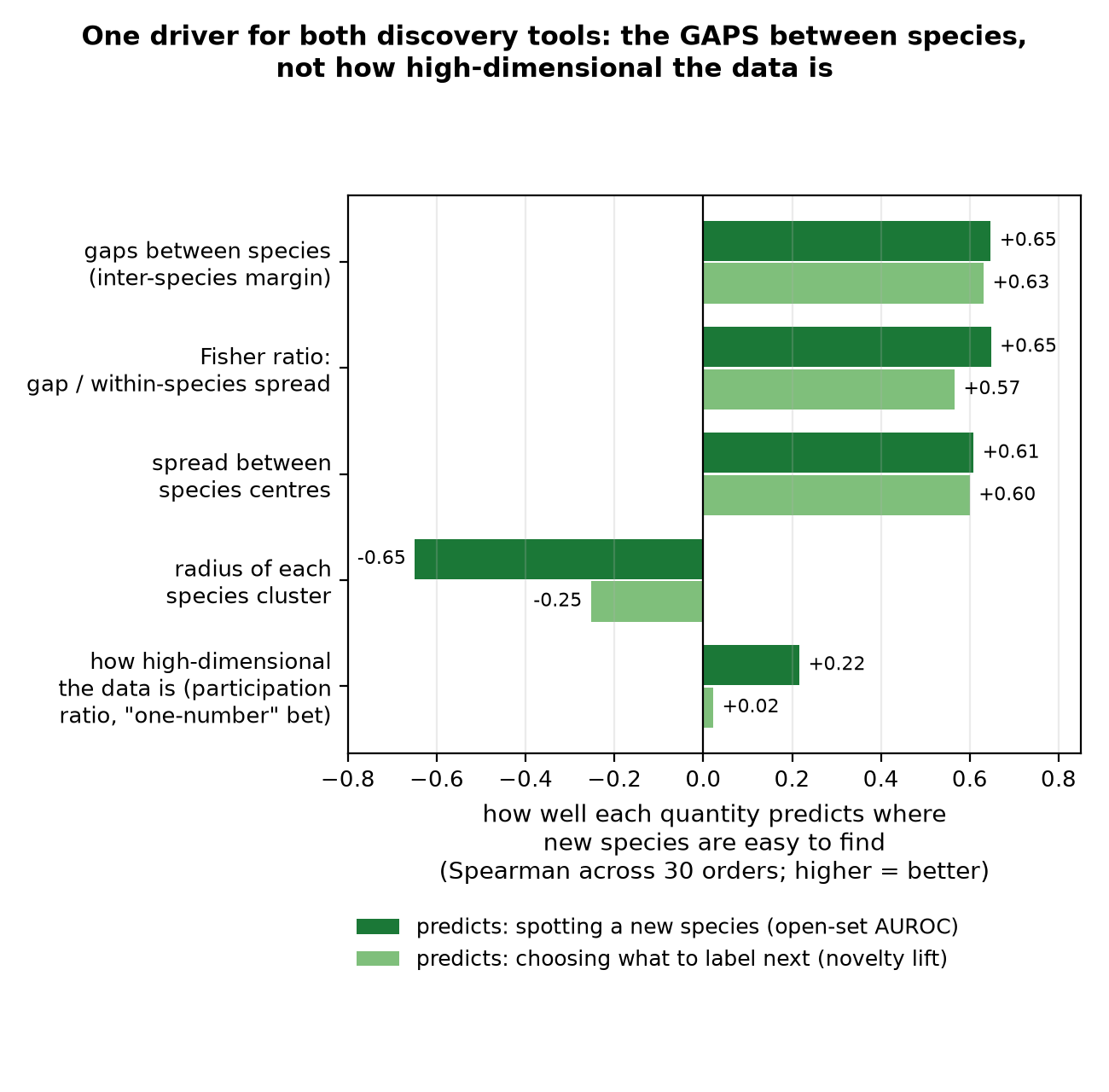
margin mechanism
Picture each species as a cloud of points. If the clouds sit apart with clear gaps, an unknown species lands in a gap and stands out. The inter-species margin governs both discovery tools (+0.65 / +0.63 within-dataset; cross-realm ceiling-controlled partial ρ=+0.31, 934 cells, FWER p<1e−20 — the honest cross-realm effect is more modest); how high-dimensional the data is (the one-number bet) governs neither (+0.22 / +0.02).

The detector is the geometry
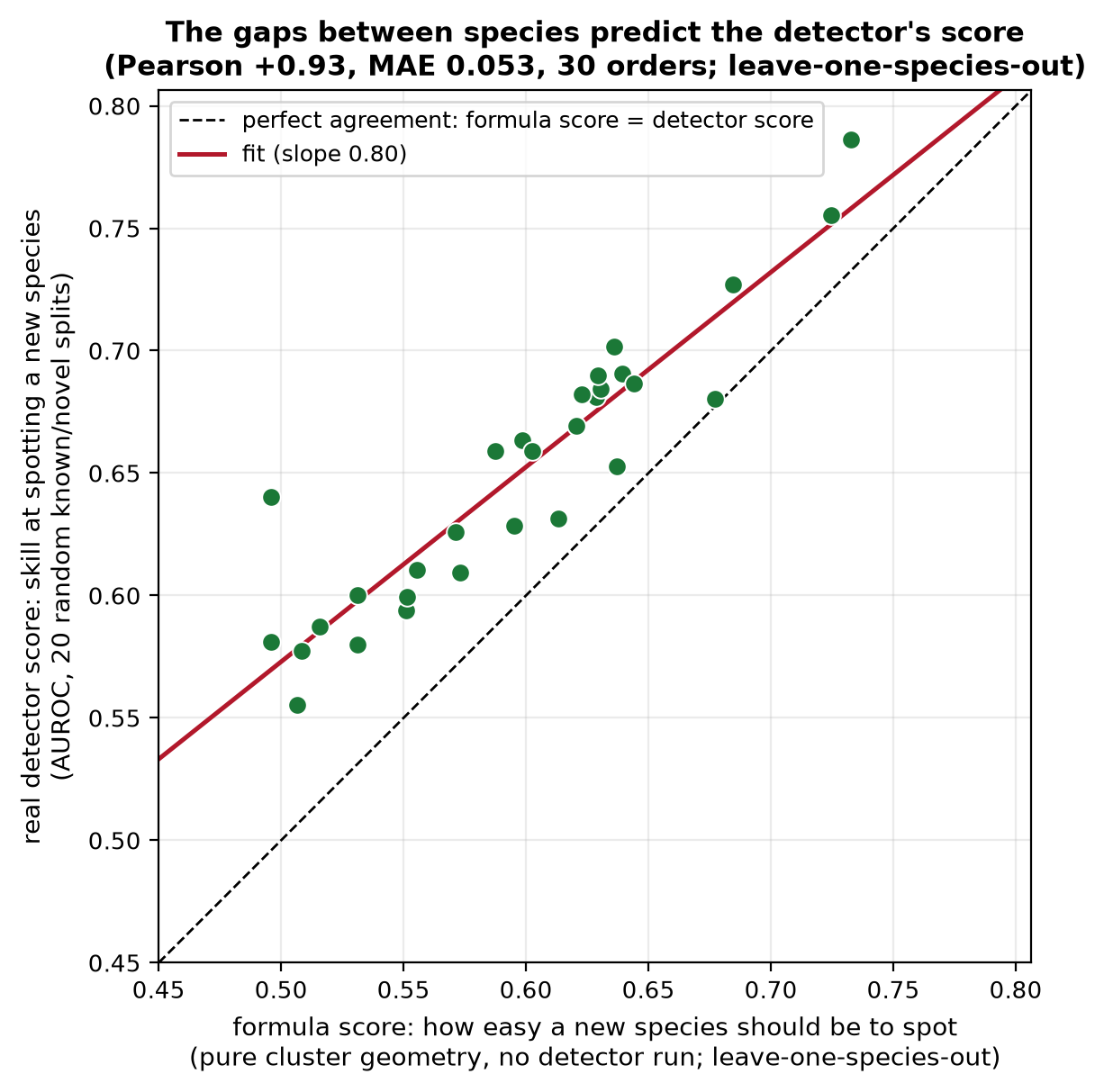
closed form predicts AUROC
A closed-form cluster separability predicts the actual open-set detector's per-clade accuracy at Pearson 0.93, with no detector run and under a genuine leave-one-order-out recompute. The geometry doesn't merely correlate with the detector; it predicts its score, up to a small constant offset.

The honest test: within-dataset is circular, transfer is not

+0.59
margin transfers to an unseen continent
leave-one-continent-out; defensible CI [0.37, 0.73], permutation p=2e-4
+0.24
effective-dimension confound
the one-number bet, same test
Within one dataset, margin and the detector read the same geometry, so that agreement alone would be near-circular. The real evidence: margin measured on five continents predicts the unseen sixth: different data, so it cannot be circular.

Both discovery tools work on every continent, untuned
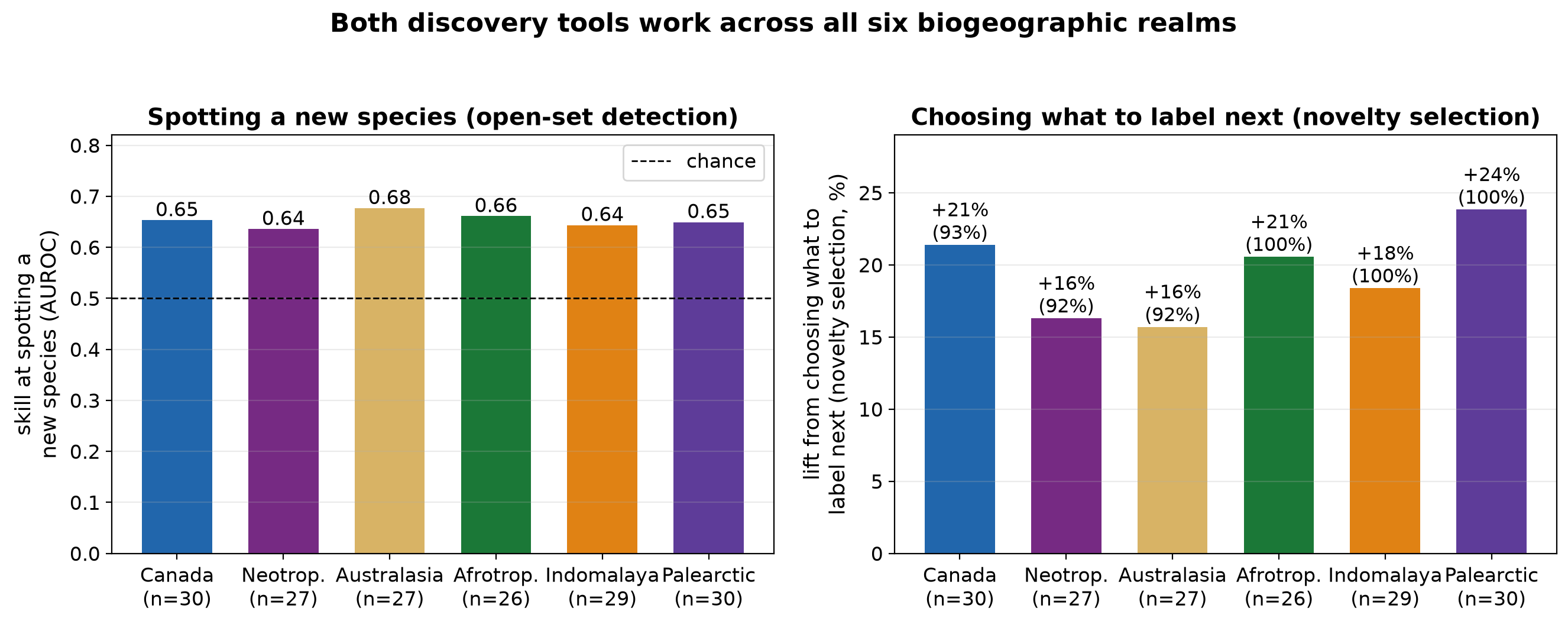
across six realms
External validation on independent iNaturalist pulls from all six terrestrial realms: the open-set detector spots new species at AUROC 0.64–0.68, and novelty-guided selection finds species +16–24% faster than random, with no tuning.

It's a property of the representation, not the benchmark
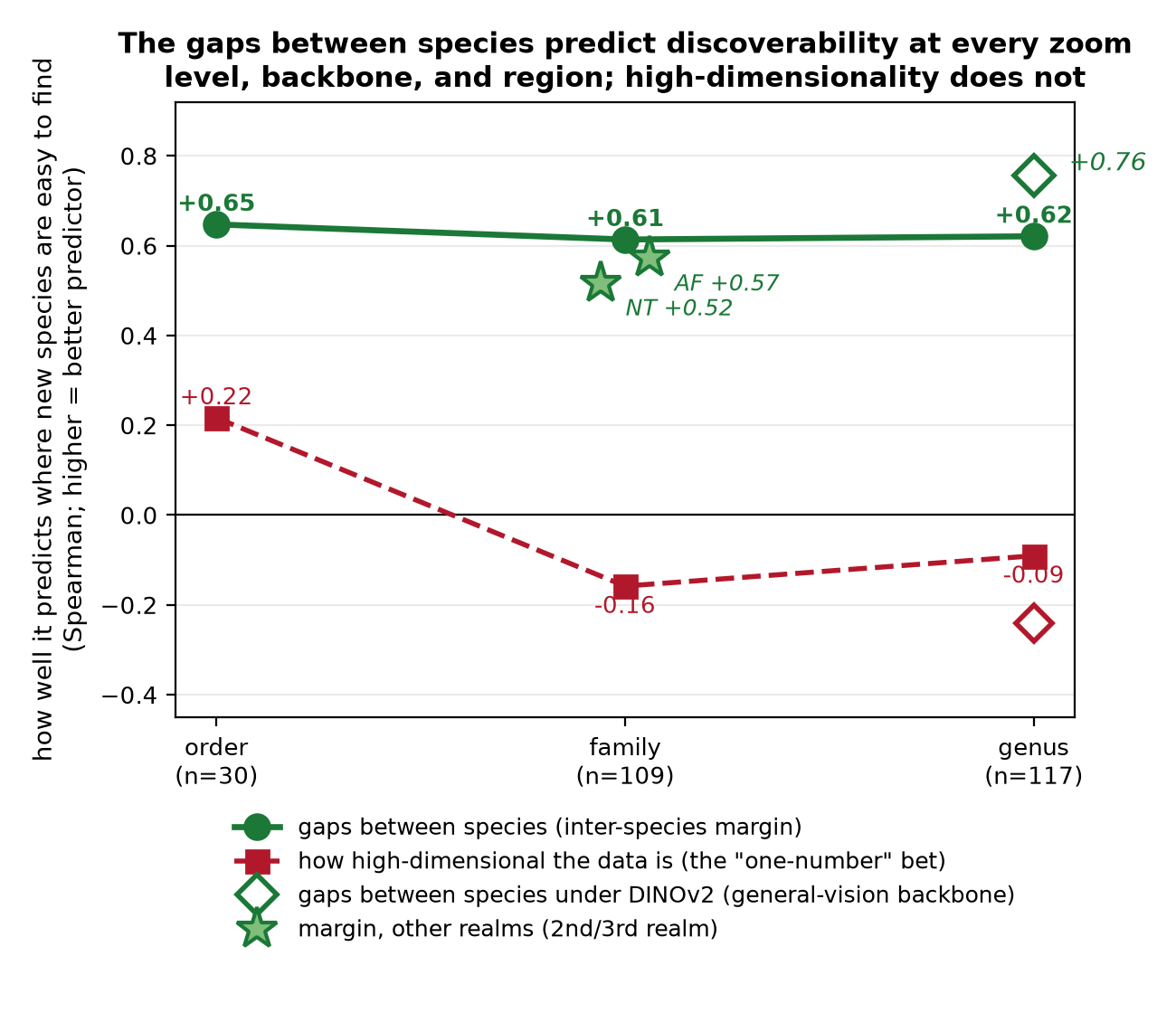
zoom, backbone, region
The margin predicts discoverability at every zoom (order +0.65, family +0.61, genus +0.62), under a different backbone (DINOv2 +0.76), and in other realms (+0.52, +0.57) (all raw within-dataset; cross-realm ceiling-controlled partial ρ=+0.31), while the one-number bet goes flat or negative. A weaker positive margin-detectability association also appears in bird audio.

And it holds on the field's own benchmarks

+0.93/+0.79
iNat2021-OSR — per-hop difficulty (Aves/Insecta)
Lang et al. CVPR’24, 7 taxonomic-distance hops; per-clade +0.71 on insects (p<10−3)
3/3
Open-Insect — difficulty tiers, scale-stable
Chen et al. NeurIPS’25, ~18k images; tier-ordering reproduced in every region (AUROC 0.86–0.99)
Two third-party benchmarks, never tuned on — the difficulty ordering transfers everywhere novelty is graded by taxonomic distance. Honest boundary: per-clade forecasting holds where clades carry variance (insects), but Open-Insect's adversarially-curated near-relatives compress it to null (+0.23). A graded-distance forecaster, not a universal per-clade oracle.

And it forecasts genuinely region-novel species
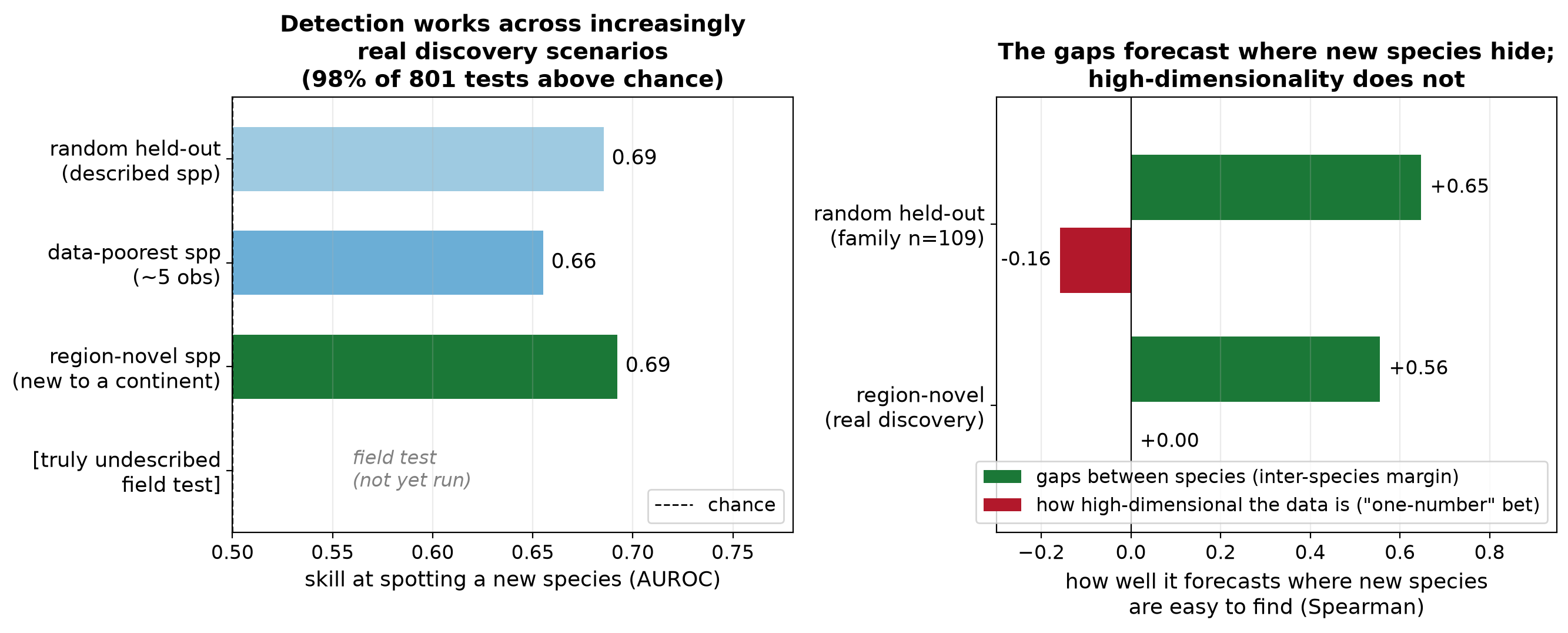
region-novel discovery
The detector holds from random held-out species (0.69) through the data-poorest (0.66) to genuinely region-novel species new to a continent (0.69). The margin forecasts which clades hide them at +0.56, where the one-number bet gives ~0.

What it buys you, and how cheap it is

0.66
open-set AUROC, untuned
across 30 orders, above chance everywhere
0.52→0.65
no labels → a few labels
unsupervised triage, then the worth of a handful of labels per clade
Operationally: run a training-free first pass using a small labelled reference set, then spend labels only where the rough signal says discovery will pay off.

What this does and doesn't claim

  • It tells you where discovery is easy (which taxa, which regions), not which model to use. Swap the backbone and the margin and the accuracy move together, so the signal is real across datasets and difficulty, not across models.
  • Detecting a whole new lineage (a held-out genus) is harder than a new species with known cousins (AUROC 0.59 vs 0.65). Closing that gap is what the field trial targets.
  • Checked for leakage: on species the backbone never saw, the detector still scores 0.69–0.76, at or above the random-novel baseline, so the headline isn't inflated by familiar names.

It reaches real discovery

0.92
AUROC on 116 genuinely out-of-training species
absent from BioCLIP’s training manifest — truenovel benchmark
+0.92
margin forecasts per-species detectability
Spearman, n=116, p=4e−49
The random-held-out proxy scored 0.73 — it was understating. On species the foundation model has never seen, the detector holds and the pre-flight still forecasts which ones it will find. And it isn’t a BioCLIP quirk: re-run on a label-free backbone (DINOv3, n=150, no species labels → nothing to leak), the per-species forecast holds even sharper at +0.988. Caveat: this is broad cross-fauna detection (novel vs the whole known fauna), an easier regime than within-clade congeners (0.58–0.66). The two bracket the difficulty range.

What's new, and what's next

  • We're not aware of prior work linking a training-free cluster-isolation scalar to open-set species discovery before any model is trained or budget spent — Janiak et al. (2510.15202) independently converge on the geometry principle (OOD target, within-model); we tested both cross-realm and their predictor transfers comparably, so cross-domain transfer is a shared property of the isolation principle — convergent validation, our distinctions being the closed-form identity and the open-set-discovery target.
  • The empirical law is the floor; the next step is a bound: under a margin / low-noise condition, the inter-species margin lower-bounds the expected information gain of a query.
  • The same pre-flight drives two further results: discovering unknown species under a budget, and where to sample next on the map.
Predict where discovery pays off, before you pay for it.

Thank you

The geometry of foundation-model embeddings is a training-free map of where discovery is easy (small reference set required).
margin governs both discovery tools · transfers to unseen continents · backbone- and resolution-invariant

Wietze Suijker, wietze.suijker@mila.quebec
Every number reproduces from committed pilot scripts

Appendix: two axes, two specialists

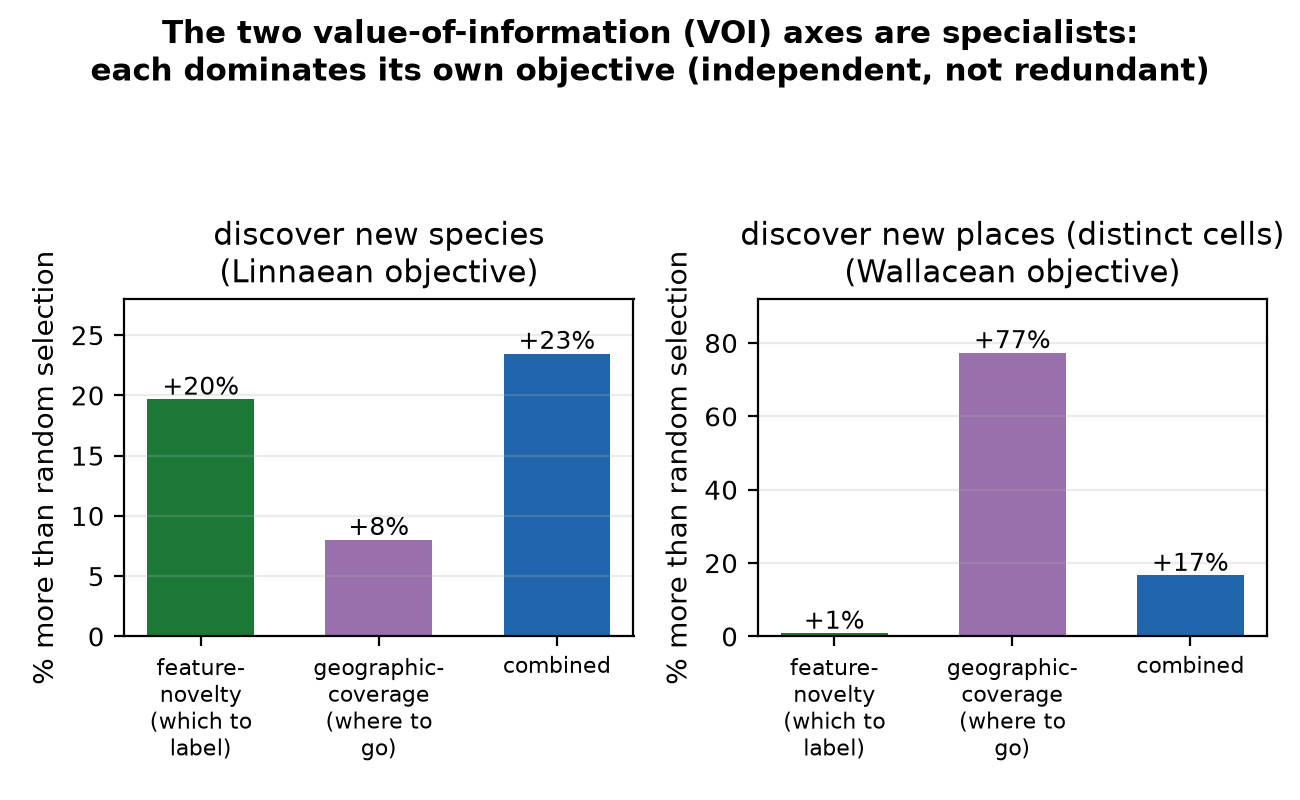
two-axis decoupling
The refuted bet, made useful.
  • Feature-space novelty wins for species discovery (+20% over random); spatial coverage barely moves it (+8%).
  • Spatial coverage wins for geographic cell coverage (+77%); novelty barely moves it (+1%).
  • Different signal wins in each space, which is why one number can't span both, and why the pre-flight is irreducibly two-dimensional.