Where to look next

Value-of-information sampling for a continental bioblitz
Wietze Suijker
spatial value-of-information · iNaturalist

The other half of discovery: where

Finding which species exist is one shortfall. Knowing where they are is the other. Where should naturalists be sent so each observation-hour discovers the most?
The score: per map cell, combine observation density (under-sampling), recency, climate coverage, species-at-risk rarity, and recent forest loss, a value-of-information estimate of what a cell still hides.
where-to-blitz · live · zoom out for all of Canada, click a cell for its gap breakdown · open ↗

It survives the honest test: a leakage-free backtest

0.49–0.64
priority ↔ actual discovery
40/40
configurations robust
every density / effort setting tested
Score cells on the past, hide the future, then check: do high-priority cells out-discover low-priority ones at equal effort? Yes. The priority map predicts where discovery actually happens.

The honest negative that shapes the approach
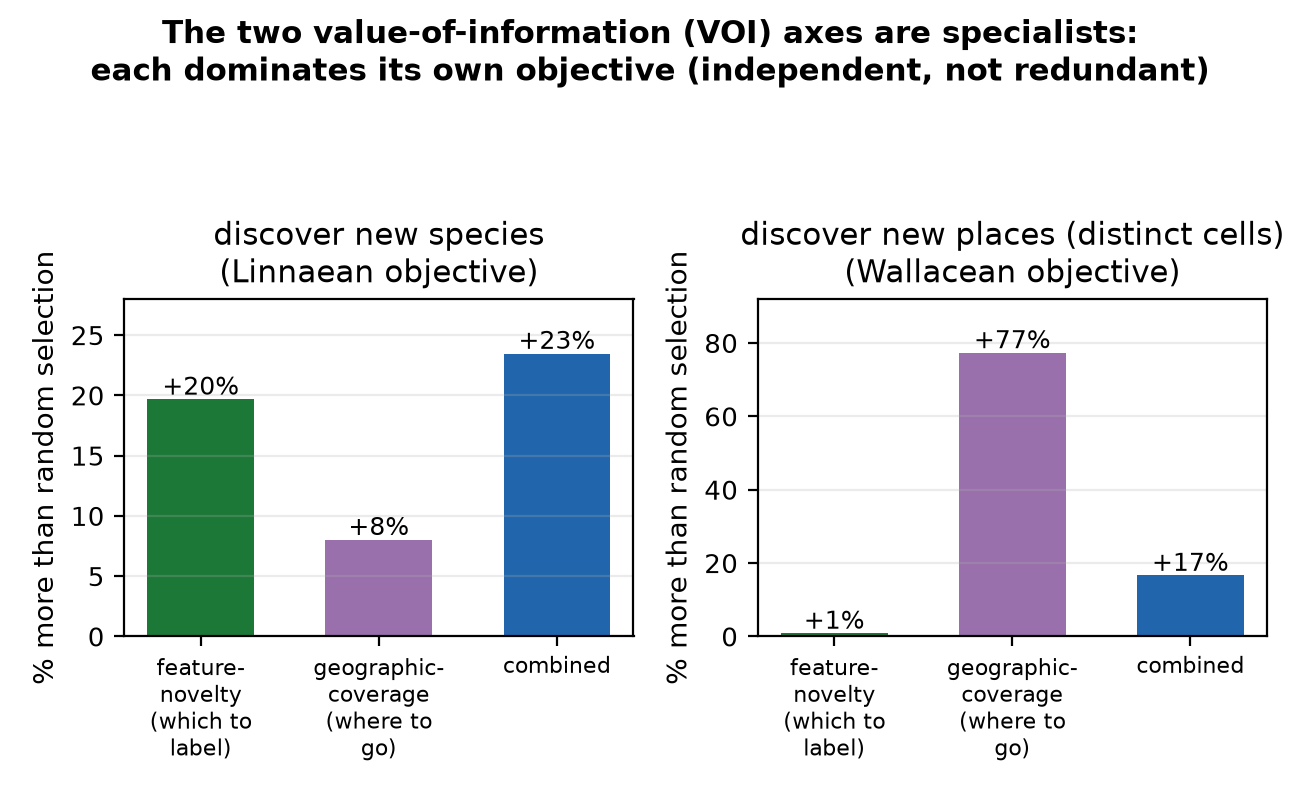
VOI axes are specialists
The feature-space winner (embedding novelty) does not win geographically. For covering distinct map cells, spatial coverage beats novelty +77% to +1%; novelty wins only for species discovery (+20%). Different signal wins in each space.

Why one number can't span both
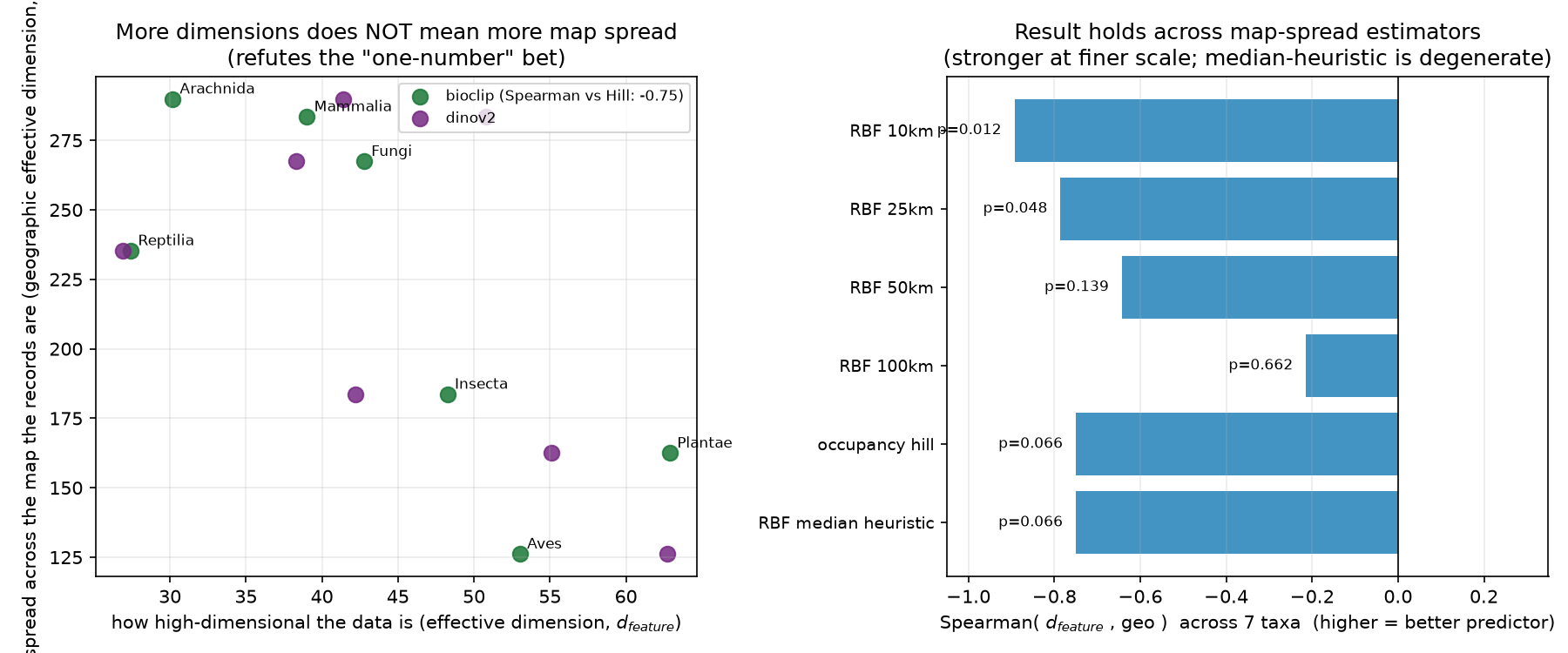
effective dimension decoupled
More embedding dimensions does not mean records spread wider across the map: the “one-number” bet refuted, and the refutation is robust across every map-spread estimator. The feature and geographic axes are statistically decoupled (Spearman −0.06).

Across realms, two axes beat either alone

+21.7%
joint VOI over random
vs feature +15.3%, geographic +2.2% alone (6 realms pooled)
+5.1%
joint over best single axis
strictly better in 24 of 26 cells
Honest scope: the two pre-flights are redundant within a single realm (the per-realm gain is not significant) and complementary only when realms are pooled, because geography then carries disjoint species pools. That is itself the evidence for two genuinely distinct shortfalls.

Allocating a real budget

~92%
of an oracle's discoveries
VOI-guided allocation across 30 orders
~87%
uniform allocation
the “spread it evenly” baseline
Guided allocation closes 37–45% of the gap to an all-knowing oracle (+5–7% over uniform), on a continent's worth of clades, before a single new trip.

And you can rank a region you've never sampled
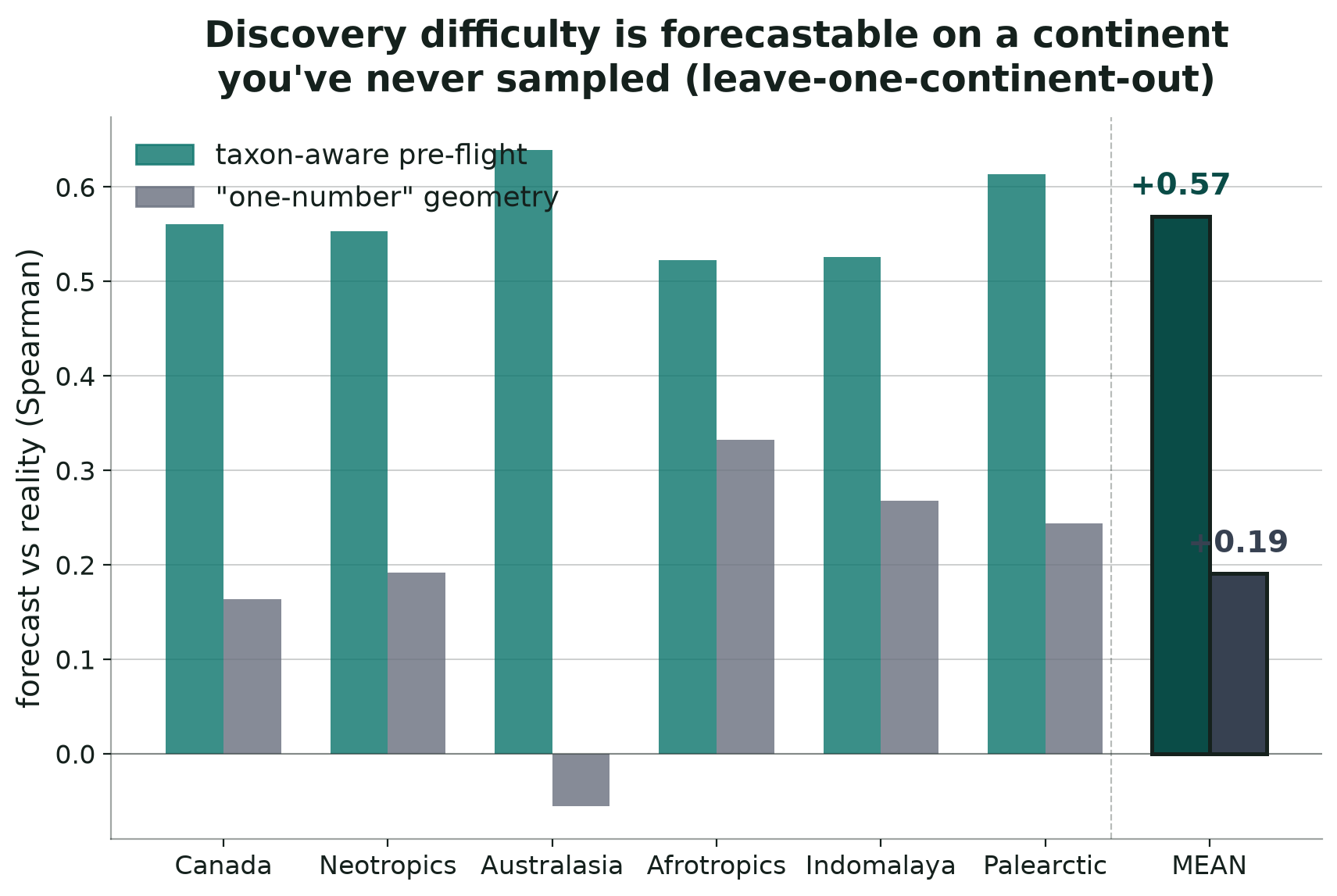
leave-one-continent-out forecast
Leave-one-continent-out: a taxon-aware pre-flight forecasts an unseen continent's per-clade discovery difficulty at +0.57, versus +0.19 for the one-number geometry. Difficulty travels with the branch of the tree of life, so you can prioritise before arriving.

From backtest to cause: a ladder, not a leap

  • Rung 1 (done): the observational leakage-free backtest above.
  • Rung 2 (base case): a difference-in-differences across seasons, a real causal advance that doesn't depend on volunteer compliance or a third-party app.
  • Rung 3 (upside): a field-randomized bioblitz trial, pursued only if app-modification + ethics sign-off align in time. The causal claim no longer rests on one fragile experiment.

Responsible by construction

  • Fine-grained location prediction can aid exploitation of at-risk species. So the live deployment exposes only coarse, species-summed at-risk richness, never an individual locality, with an explicit “planning aid, not ground truth” caveat in the app itself.
  • Species-at-risk exposure masking and CARE/OCAP Indigenous data governance are first-class constraints, not afterthoughts.
  • The north-star metric is discoveries per human-hour, evaluated in the open.

Thank you

Where to sample is a value-of-information question: answerable, leakage-free, and genuinely separate from what to label.
ρ 0.49–0.64 backtest · coverage beats novelty geographically · joint VOI +21.7%

Wietze Suijker, wietze.suijker@mila.quebec
Engine: blitz-the-gap · evidence reproduces from committed pilot scripts