Two Shortfalls, One Pre-flight

Efficient species discovery as value of information
Wietze Suijker
the big picture · two spaces, one pre-flight

Two ways we are blind to biodiversity

Linnean shortfall (what exists)

  • most species are still unnamed
  • which observation should a taxonomist label next?

Wallacean shortfall (where they are)

  • most known species are barely mapped
  • where should a naturalist go observe next?

One problem, not two: value of information

Both are the same question (where will the next unit of human attention pay off most?), posed in two spaces: the feature space of foundation-model embeddings (which to label) and the geographic space of sampling effort (where to go).
Each space carries a training-free pre-flight: a cheap, a-priori estimate of where discovery is easier, computable before any model training, using a small labelled reference set for the feature-space axis.

One number fails; the pre-flight holds and forecasts
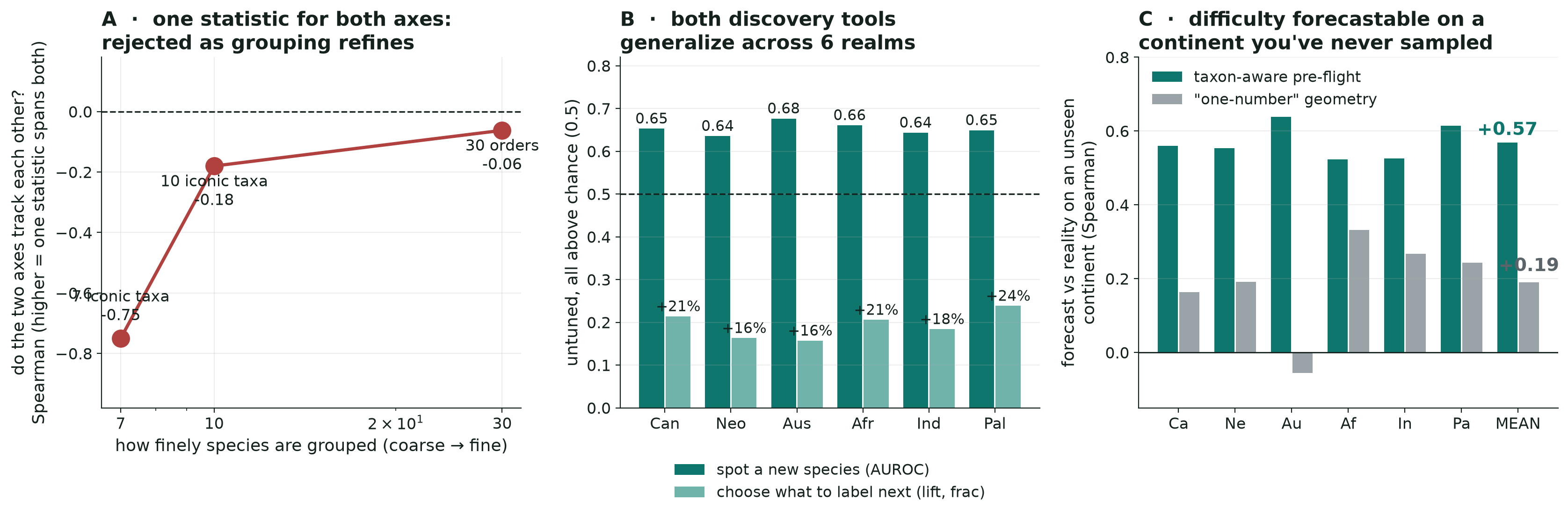
three pilot findings: shortcut rejected, generalizes, forecastable
One story in three panels. (A) The tempting shortcut, a single number meant to explain both what to label and where to look, is rejected. (B) Yet the training-free pre-flight and its two discovery tools still work across all six biogeographic realms. (C) And it forecasts how hard discovery will be on a continent you've never sampled (+0.57, vs +0.19 for the shortcut).

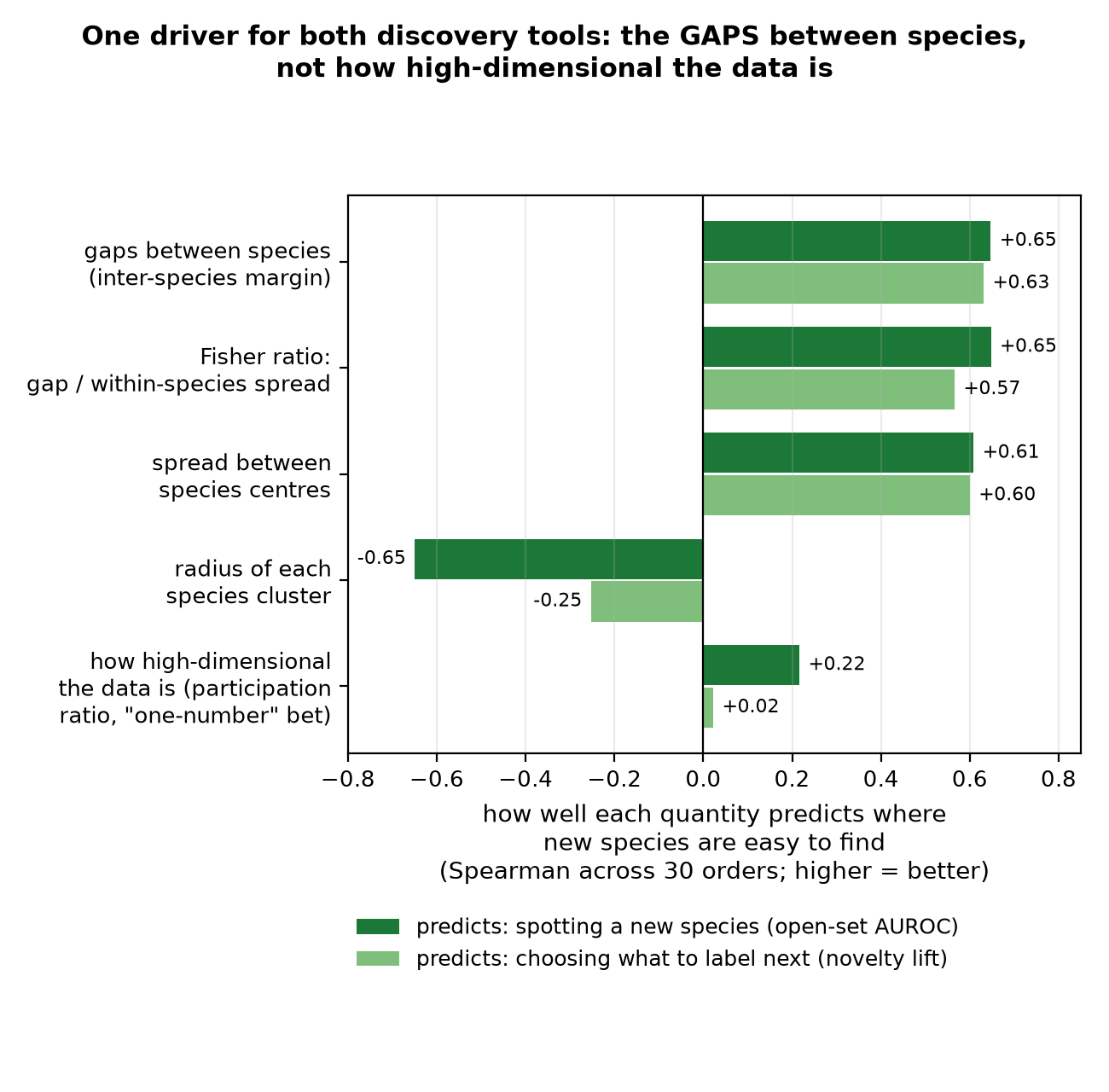
The mechanism: gaps between species, not cloud size
margin mechanism
The pre-flight is the inter-species margin: how clear the gaps between species clusters are. It governs both discovery tools (+0.65 / +0.63 within-dataset; cross-realm ceiling-controlled partial ρ=+0.31, 934 cells, FWER p<1e−20); how high-dimensional the data is (the one-number bet) governs neither.

The detector is the geometry — off data I didn't build

+0.995
closed-form = open-set AUROC, iNat2021-OSR
binormal d′ identity, no detector trained
+0.997
same identity, TerraIncognita
MAE 0.013–0.017; two benchmarks I did not build
The classical AUROC = Φ(d′/√2) identity, fed a frozen-embedding d′, reproduces the empirical detector with no detector trained and no label spent — and even predicts the two sub-chance clades correctly (Coleoptera d′<0 → AUROC 0.37, empirical 0.38). This is the leakage-free anchor; the 116-species out-of-training result is corroboration, not the headline.

Three results

  • The Geometry of Discovery: the margin pre-flight predicts open-set discovery and transfers to unseen continents (+0.59); the detector is the geometry (Pearson 0.91). Leakage-free real-discovery benchmark: 116 out-of-training species at AUROC 0.92 (vs random-novel proxy 0.73; margin forecasts per-species detectability at +0.92).
  • Novelty is not Rarity: open-set discovery on tropical crowns under a budget; a two-pronged pre-flight; a botanist-queue trial we control.
  • Where to look next: geographic value-of-information; the honest negative that coverage, not novelty, wins here; the two axes are decoupled.

Why the two axes are separate, and that's the point
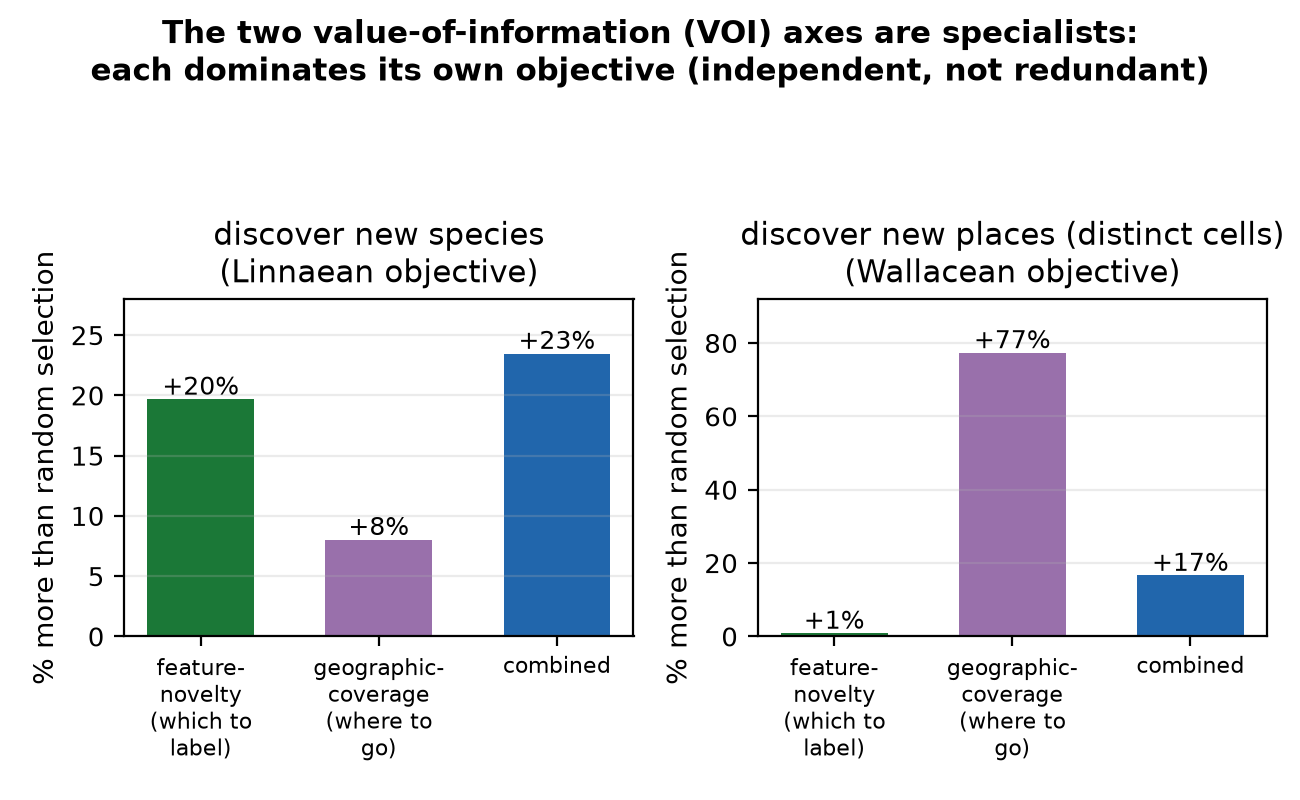
two axes specialists
Feature-novelty wins for discovering species (+20%); spatial coverage wins for covering places (+77%). Each axis is a specialist: neither can be read off the other, so the pre-flight is irreducibly two-dimensional.

The result survives its own controls

−0.06
unifying hypothesis: rejected
effective dimension, both axes, 30 orders; 95% CI includes zero
Two controls guard the claim. (1) Falsification: the single-statistic hypothesis is rejected outright, a negative result that establishes the two axes are non-redundant, not a setback. (2) Leakage: the margin–detector link is re-checked for self-membership bias; a leave-one-order-out recompute strengthens it (Pearson 0.91 → 0.93), so the headline isn't inflated by names the geometry already saw.

It reaches real discovery

0.92
AUROC on 116 genuinely out-of-training species
absent from BioCLIP’s training manifest — truenovel benchmark
+0.92
margin forecasts per-species detectability
Spearman, n=116, p=4e−49
Random-held-out proxy: 0.73 — it was understating. On species the foundation model has never seen, the pre-flight still forecasts which ones it finds. Caveat: broad cross-fauna detection (novel vs the whole known fauna), an easier regime than within-clade congeners (0.58–0.66). The two bracket the difficulty range.

From correlation to cause: a ladder, not a leap

  • Done: a leakage-free backtest, where high-priority cells out-discover low-priority ones at equal effort.
  • Next: a candidate-controlled botanist-queue trial, where the labeller acts on exactly what we serve, so there is no compliance gap and no third-party infrastructure.
  • Upside: a randomized bioblitz field trial, once the field logistics and approvals align.

Thank you

Finding life, efficiently: predict where discovery pays off, before you pay for it.
The Geometry of Discovery · Novelty is not Rarity · Where to look next

Wietze Suijker, wietze.suijker@mila.quebec
Every number reproduces from committed pilot scripts